


Here’s a truth most businesses realise way too late: IT failures happen not because of the products, but because of the scattered maintenance that comes with it.
Your servers are enterprise-grade.
Your network switches come from trusted brands.
Your cameras have excellent reviews.
Everything is branded, certified, and seemingly best-in-class. Yet the IT environment falls, causing disruptions, slow fixes, and costs that keep rising year after year.
The real problem isn’t technology. It’s structure.
Most IT infrastructures are built in silos, where systems and teams operate independently. According to the Uptime Institute, the majority of enterprise outages are caused by process, configuration, and integration issues, not hardware failure. These silos quietly increase downtime, inflate costs, and undermine reliability-without being immediately visible.

The Problem with fragmented IT
Today most organizations are following a familiar pattern. The network team handles connectivity. A different OEM is hired to take over surveillance duty. Someone else is overseeing the server maintenance. Annual maintenance contracts are signed as afterthoughts, maybe with the cheapest bidder. On paper, everything always looks organized, but in practice it’s a ticking time bomb.
This is what a fragmented approach is.
Despite a decade of digital transformation, 87% of organizations still struggle with disconnected data sources, and data silos. This fragmented approach is one of the most persistent and expensive problems in companies.
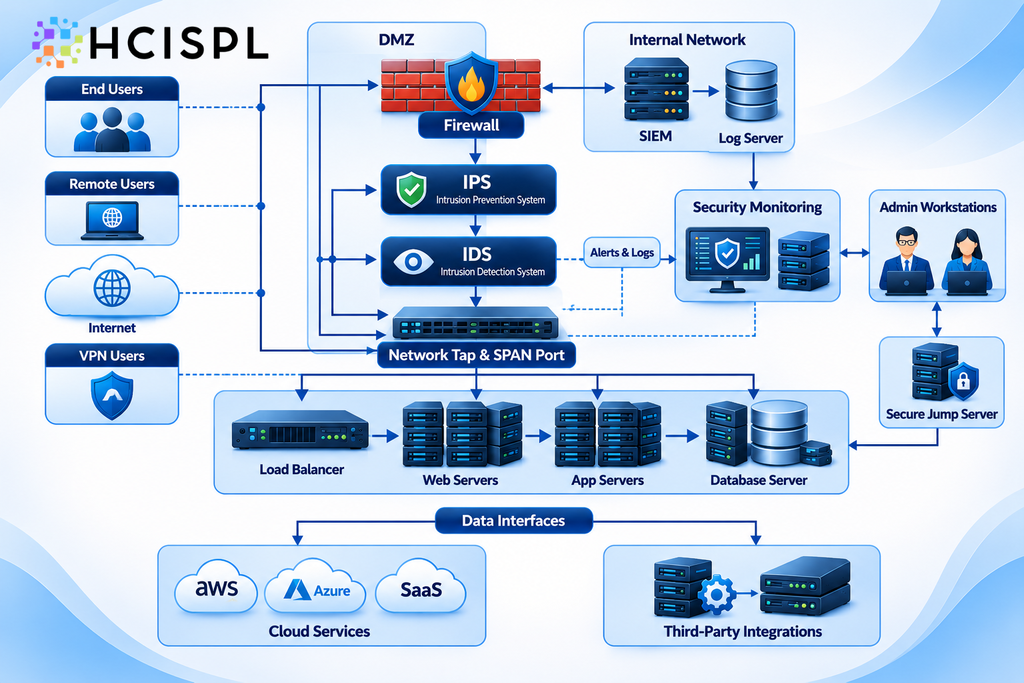
This approach is like a collection of independent parts rather than an interconnected ecosystem. Your network isn’t just about cables and switches, it is about the foundation for your communication system, your cameras, your cloud, and your data flow. When these components are managed in isolation, they work better on their own but become fragile when viewed as a whole.
Hidden Costs of Disconnected IT Management
Whenever IT systems operate in silos, the consequences extend far beyond minor problems. The impact touches every part of your business operations:
- Increased downtime- When the network goes down and affects the surveillance system, which MSP do you call first? While you are busy figuring out, your business shuts off.
- Slower resolution time- Involvement of multiple vendors leads to fragmented troubleshooting and unclear ownership. Issues that could be resolved in hours often extend into days due to the lack of end-to-end visibility.
- Wasted resources- Time spent managing multiple vendors and resolving coordination gaps reduces focus on strategic initiatives and increases operational costs. Studies highlight that businesses lose an average of 20–30% of their IT productivity due to poor coordination and fragmented system management.
- Scattered control- When multiple vendors are involved, control is spread across different teams. If a service fails, responsibility becomes unclear, accountability shifts between providers, and resolution is delayed. In siloed environments, issues remain unresolved longer due to the lack of clear ownership.
- The blame game- This is often the most challenging consequence of fragmented IT environments. When multiple IT vendors are involved, accountability becomes unclear. Issues are deferred between vendors, configuration responsibilities are disputed, and support teams cite information gaps. During this time, business operations are impacted, and internal teams are forced to manage escalations rather than focus on core priorities.
How Fragmented IT Impacts Business Growth?
An overview of the impact of fragmented IT infrastructure:
- Slower expansion and scaling – Opening new offices or onboarding new teams requires coordinating multiple MSPs, and OEMs, delaying deployments and increasing complexity.
- Delayed time-to-market – Fragmented systems slow down IT readiness for new projects, product launches, or client commitments.
- Higher operational costs – Duplicate tools, overlapping contracts, and emergency fixes inflate IT spend without adding business value.
- Reduced agility – Siloed systems make it harder to adapt quickly to market changes, customer demands, or competitive pressures.
- Increased business risk – Poor visibility across systems weakens security posture and incident response during critical events.
- Leadership distraction – Management time is wasted resolving IT issues instead of focusing on growth and strategy.
- Inconsistent customer experience – System failures or slow performance directly impact service reliability and brand trust.

What HCISPL has for you?
Hazelnut Cyborg Infra Solutions Pvt. Ltd. believes IT infrastructure should enable business growth, not slow it down. Our managed services model is built on one principle: treat your entire IT environment as a single, integrated ecosystem- not disconnected parts.
Here’s how our integrated approach directly addresses the challenges of fragmented IT:
Single Point of Accountability
You work with one partner for your entire IT environment. One SLA, one team, one owner. No confusion, no vendor conflicts, no finger-pointing.
Higher Uptime Through Unified Monitoring
We monitor networks, servers, applications, surveillance, and security together. Issues are identified early through correlated alerts- often before they impact operations.
Faster Issue Resolution
When something breaks, there’s no debate about who is responsible. With full visibility across systems, we diagnose the root cause quickly and act immediately.
No Coordination Headaches
Your internal team no longer manages multiple OEMs or MSPs. We handle vendor coordination, escalations, and resolution-so your team can focus on strategic work.
Better Cost Control
Integrated management removes duplicate contracts, emergency fixes, and overlapping efforts. You get predictable costs instead of surprise bills.
Clear Ownership & Strong SLAs
Responsibility doesn’t shift between vendors. Performance, availability, and resolution timelines are clearly defined and enforced across the entire environment.
Proactive, Not Reactive Support
We don’t wait for failures. Preventive maintenance, capacity planning, and performance optimization keep your systems stable and future-ready.
IT That Scales With Your Business
Opening new offices, onboarding teams, or launching initiatives becomes faster and simpler- without coordinating multiple vendors.

To Conclude
Modern businesses move faster by consolidating how their technology is managed. As organizations shift from fragmented vendor models to integrated managed services, efficiency and reliability improve. Cisco reports that MSP partners delivering integrated services saw 35% growth, while technology resellers experienced an 8% revenue decline- clearly showing that unified IT ecosystems outperform siloed approaches. Your team needs reliable technology that supports productivity, not disruption.
The question isn’t whether to move towards integrated IT management- it’s how quickly you can make the transition happen.
At HCISPL, we don’t just manage your IT system. We ensure they work together flawlessly, support your business objectives, and let you grow.
FAQs
1. Why does IT infrastructure keep failing even when the technology is high quality?
The cause is usually structure, not the products. Servers, networks and cameras may all be enterprise-grade, but when they are managed separately by different teams and vendors, gaps appear in process, configuration and integration. These gaps are behind most enterprise outages.
2. What is fragmented IT?
Fragmented IT is when different parts of your infrastructure, such as network, servers, surveillance and security, are managed in isolation by separate teams or vendors. Each part may work well alone, but the whole environment becomes fragile because nothing connects them.
3. What are the hidden costs of disconnected IT management?
The main costs are:
- More downtime
- Slower issue resolution
- Wasted time and resources on vendor coordination
- Scattered control and unclear ownership
- The “blame game” between vendors
Together these raise operational costs and pull your team away from strategic work.
4. Why does managing multiple IT vendors cause longer downtime?
When something fails, it is often unclear which vendor is responsible. For example, if a network failure also takes down surveillance, you have to work out which provider to call first. Issues that could be fixed in hours can stretch into days because no one has end-to-end visibility.
5. How does fragmented IT affect business growth?
It slows expansion because new offices or teams require coordinating several vendors. It also delays time-to-market, raises costs through duplicate contracts and tools, reduces agility, weakens security visibility and distracts leadership. It can also hurt customer experience when systems fail.
6. What is an integrated IT services model?
It treats your whole IT environment (network, servers, applications, surveillance and security) as one connected ecosystem managed by a single partner. This replaces separate vendors and contracts with one team, one SLA and one point of accountability.
7. How does a single point of accountability improve IT support?
With one partner and one SLA, there is no confusion over who owns a problem and no finger-pointing between vendors. Responsibility, availability and resolution timelines are clearly defined, so issues are diagnosed and fixed faster.
8. How does unified monitoring reduce downtime?
Unified monitoring watches networks, servers, applications, surveillance and security together. Correlated alerts help spot issues early, often before they affect operations, and make it easier to find the root cause quickly.
9. Can integrated managed IT services help control costs?
Yes. Integration removes duplicate contracts, overlapping efforts and costly emergency fixes. You get predictable costs instead of surprise bills, and your team spends less time managing multiple OEMs and MSPs.
10. How can HCISPL help if my IT is spread across multiple vendors?
Hazelnut Cyborg Infra Solutions Pvt. Ltd. (HCISPL) manages your IT environment as a single integrated system. It handles vendor coordination and escalations, provides unified monitoring, proactive maintenance and clear SLAs, and supports scaling as you open new offices or launch new initiatives.
Fact-check before publishing: the blog cites some statistics (87% of organizations with data silos, a 20–30% productivity loss, Cisco’s 35% MSP growth). If you use them in the FAQs, check that the sources still support them. I left the specific numbers out of the FAQs to be safe.